.webp?width=400&height=225&name=Untitled%20design%20(39).webp)
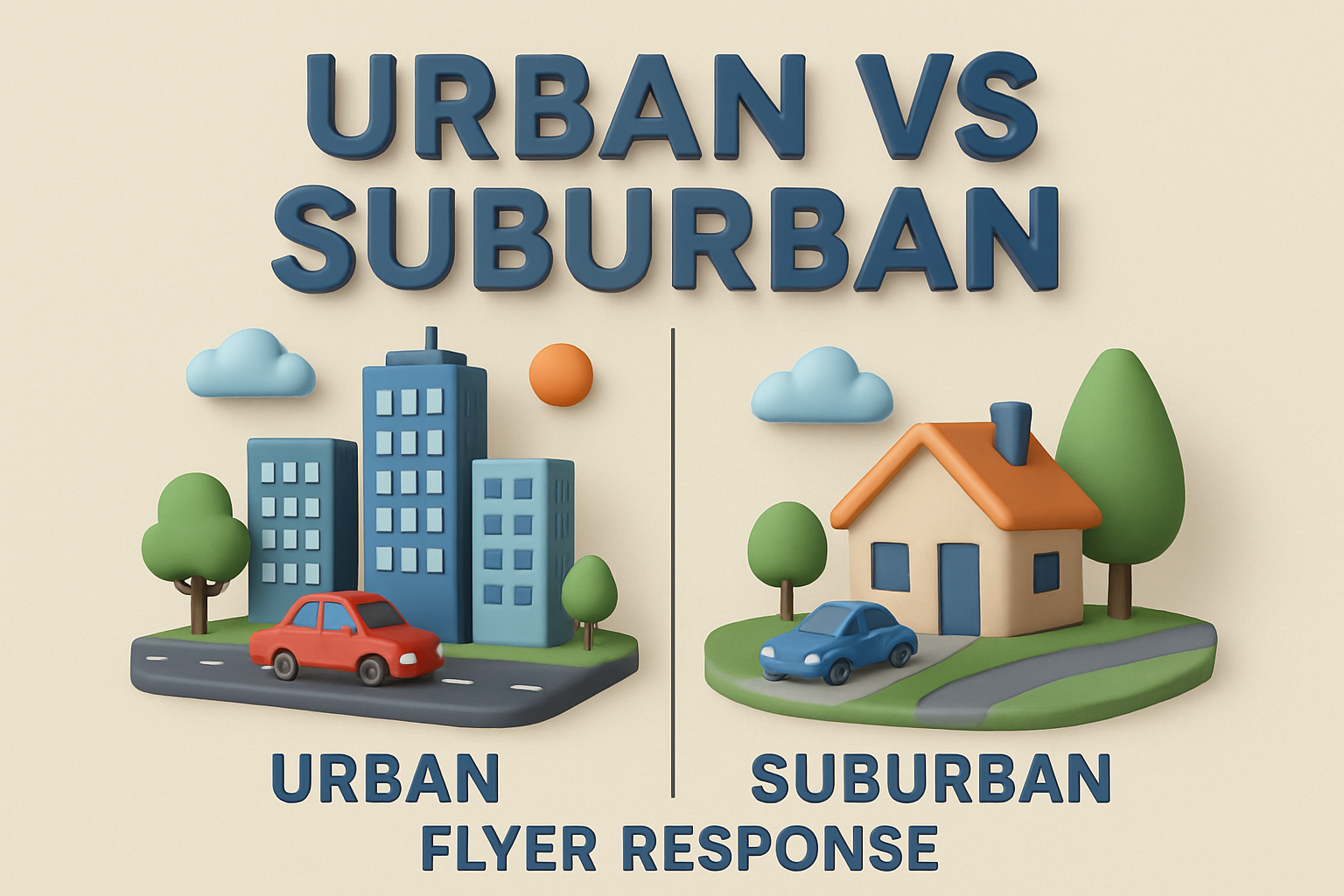

Urban vs Suburban Flyer Response: What Our Data Shows

Emerson Buhat
One of the most common questions we hear is whether flyers perform better in urban or suburban areas. The assumption is often that dense city neighbourhoods deliver stronger results because more people live closer together. But when we look at real campaign data across Canada, the answer is more nuanced. Both environments perform well, but for different reasons.
Here at Flyer Canada, we’ve delivered campaigns in downtown cores, condo corridors, suburban developments and quiet residential streets. Over time, clear patterns emerge. Understanding how urban and suburban audiences respond helps businesses choose the right routes, messaging and timing for their goals.
Urban areas deliver fast visibility
Urban neighbourhoods move quickly. People are exposed to more information, more businesses and more offers every day. Flyers in these areas tend to generate faster initial engagement, especially when the offer is relevant and easy to act on.
Restaurants, gyms, events, clinics and service providers with walk-in or short travel expectations often see strong early response in urban zones. The proximity and convenience factor plays a major role. When something is close, people are more willing to try it.
For insight into improving quick engagement, explore How to Make Flyers Impossible to Ignore.
Suburban areas build deeper familiarity
Suburban flyer response often develops more steadily. Households are more settled, routines are more predictable and families tend to stay in the same area longer. This creates strong conditions for repeated exposure.
In suburban neighbourhoods, flyers benefit greatly from consistency. Quarterly or seasonal drops build recognition quickly, which is why many suburban campaigns show strong lift after the second or third delivery.
This familiarity contributes to our overall 4.4% average conversion rate and is a key reason suburban campaigns often achieve strong ROI over time.
To learn more about consistency, visit Why Consistency Matters: The Power of Quarterly Flyer Drops.
Housing types influence response patterns
Urban areas often include condos and apartments with shared mailrooms. Flyers here need clear placement and strong headlines to stand out among other materials. Suburban homes typically receive flyers directly at the door or mailbox, which increases individual visibility.
Each environment requires a slightly different delivery strategy. When placement matches the housing type, response improves significantly.
For more on placement and delivery accuracy, visit How to Deliver Flyers That Actually Get Read.
Offer type matters more than location
While environment shapes behaviour, the offer itself is often the deciding factor. Urban audiences respond well to convenience-based offers, limited-time promotions and services within walking distance. Suburban audiences tend to engage more with family-oriented services, home improvement and long-term value offers.
Matching the offer to the environment is one of the reasons flyer marketing continues to reduce customer acquisition costs by 51.8% across our campaigns.
To understand how offer alignment improves performance, explore 10 Flyer Marketing Strategies That Actually Work.
Tracking reveals where ROI grows strongest
When we track QR scans, promo code use and booking behaviour, both urban and suburban areas can deliver ROI between 3× and 29×. The difference is usually timing, not potential.
Urban campaigns often peak quickly. Suburban campaigns build momentum more gradually but sustain performance longer. Knowing this helps businesses plan expectations and optimize follow-up.
For more on tracking and analytics, visit How We Track Flyer Campaign Results With QR Codes and Real Analytics.
Blended strategies perform best
Many of the strongest campaigns use a mix of urban and suburban routes. This balances fast visibility with long-term stability. Urban routes spark immediate awareness. Suburban routes build lasting presence.
Here at Flyer Canada, we often recommend blended strategies for businesses looking to scale locally without over-relying on a single environment.
To explore how local visibility builds trust, visit Why Flyers Work for Canadian Entrepreneurs.
Final thoughts
Urban and suburban flyer campaigns both perform well when planned correctly. The key is understanding how people live, move and decide within each environment. Flyers are flexible enough to succeed in both settings, as long as the message, offer and delivery align with the neighbourhood.
Here at Flyer Canada, we use real delivery data to guide every campaign. With strong targeting, thoughtful timing and consistent tracking, flyers continue to deliver predictable results across cities and suburbs alike.
If you want help deciding where your next campaign should focus, reach out through our contact page, explore our store, or call 437 524 5287.
We’re ready to help you choose the routes that deliver the strongest response.